

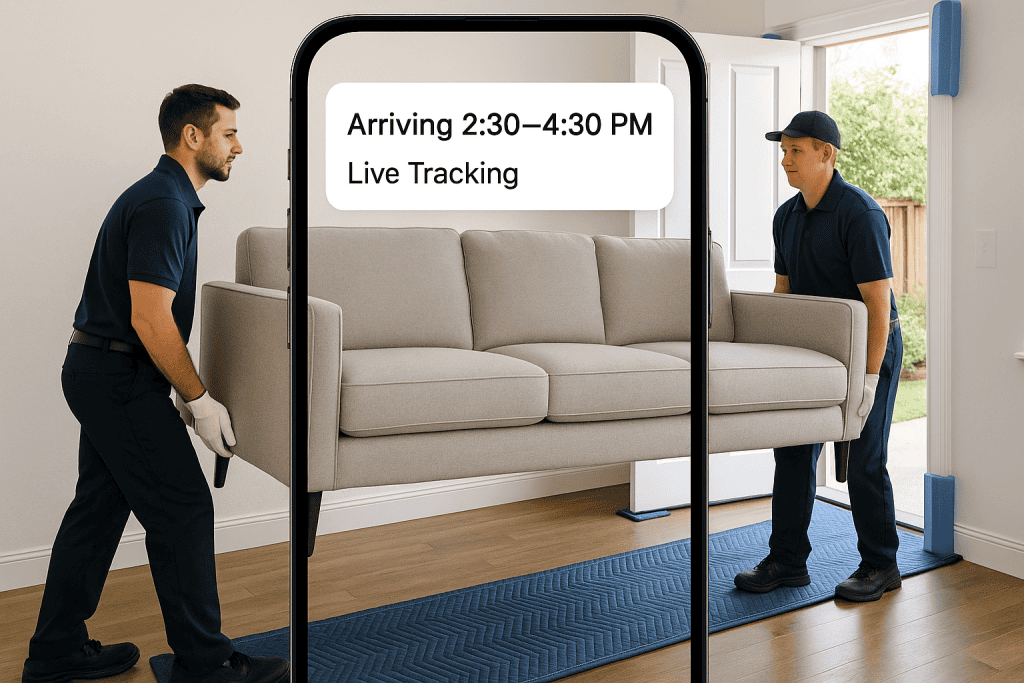
White-glove delivery for big and bulky items (furniture, appliances, fitness gear) makes a promise: we will do the heavy work and the tiny details. The promise breaks when systems are messy, people guess, and billing trails behind. This article shows a clean path to build a white-glove service that keeps customers calm, crews confident, retailers informed, and invoices accurate—every single day.
Why White-Glove Fails Without Systems
White-glove work lives in the last mile, where time is tight and expectations are high. If your tools are scattered or your steps are unclear, small misses grow into big problems.
Many Vendors, Many Rules, One Promise
You receive orders from many retailers and marketplaces. Files look different. Notes live in different fields. Service rules, haul-away needs, and brand requirements vary. Yet the customer hears just one promise: We will arrive on time, handle with care, set up right, and leave the space clean.
When your tech stack does not agree on “one truth,” your team spends the morning searching, calling, and guessing—instead of delivering.
The Cost of Manual ETAs and Billing
Manual ETAs create “we’re on the way” messages that are late or wrong. The result is WISMO calls (“Where is my order?”), rushed crews, and missed windows.
Manual billing is worse. Rates, fuel, extra KM, out-of-zone, delay blocks, and status fees (delivered, failed, refused, not-home) are easy to mis-calculate. Disputes rise. Cash slows. Morale dips.
If one link slips, the whole chain rattles.
The Core Stack (Order → TMS → Tracking → Billing)
Your goal is a single flow of truth. Orders arrive. The TMS plans. Customers see live tracking. Billing mirrors what happened. No retyping. No copy-paste. No mystery.
Data Mapping & Address/Service Validation
Start at the source:
- Normalize fields from every retailer to one schema.
- Validate addresses and phone numbers before routing.
- Confirm service type (delivery, install, room-of-choice, haul-away, returns).
- Separate service lines from inventory so serial tracking stays clean.
This is where calm mornings begin. Clean data makes clear plans.
Real-Time Customer Notifications & Live ETA
Send short, friendly messages on a simple rhythm:
- Order confirmed (what to expect + prep tips)
- Day-before reminder (window + reschedule link)
- On the way (live map + ETA)
- Arriving soon (10–20 minutes)
- Delivered (thank you + care notes)
The same status events update the TMS, retailer systems, CSR console, and billing. Everyone sees the same truth—fast.
Delight at the door starts in the data.
Field Excellence (CSRs + Trained Crews)
People make the promise real. Give them clarity and simple tools, then let them shine.
One CSR Console (status, photos, reason codes)
CSRs need one screen to calm any caller:
- Search by order, customer, serial, or route
- See live status (received, staged, loaded, en route, delivered)
- View photos + POD and reason codes
- Trigger reschedules and exception flows in seconds
Clarity makes calls short and kind. Clarity is a service.
SOP Ritual: Walk-through, Protect, Install, Proof, Care
Train crews on a short ritual they can do well every time:
- Walk-through: confirm room, path, stairs, and protection plan
- Protect: corner guards, blankets, shoe covers, floor runners
- Handle: two-person lifts, straps, door swing checks
- Install/Test: level, connect, power on, quick function check
- Proof: before/after photos; capture serials if required
- Care: quick clean-up; show features; answer one question
- Sign-off: digital POD and notes for any follow-up
Ritual beats hustle.
Automation That Pays for Itself
Automation does not replace people; it removes friction so people can do the human work better.
Auto Status, POD/Photo, KPI Pack
- Auto status updates: every key event posts to TMS, retailer, tracking page, and CSR console.
- Auto proof: POD + photos send to retailers by email or API the moment a job closes.
- Auto KPIs: daily/weekly packs for leadership and ops:
- On-time %
- First-attempt success
- Damage rate
- Delay minutes by cause
- WISMO trend
- Crew scorecards (checklists + photos complete)
Leaders manage by signals, not by surprise.
Rules-Based Billing (fuel, extra KM, delay blocks, status)
Mirror the contract in a rules engine:
- Rates by postal code/zone, distance bands, or truck flat rate
- Service rates (install, room-of-choice, threshold, haul-away, returns)
- Service types (delivery, store pickup, warehouse pickup, RTV)
- Delay fees: grace period (e.g., 30 min) + incremental blocks (e.g., every 15 min), calculated from TMS events and GPS
- Status billing: delivered, delivery failed, customer not home, refused, wrong product, address error—each with the right reason code
- Out-of-zone fees at postal-code level
- Outputs: send invoices by API, EDI-210, or Excel—in minutes
Accuracy ends the argument.
Results You Can Measure
When the stack is connected and the ritual is steady, the numbers move the right way.
On-Time, First-Attempt Success, Lower Damage, Faster AR
On-time rate rises because windows and crews align with real data.
First-attempt success improves because staging and loading are precise.
Damage rate drops because protection and handling are a habit.
AR speed climbs because billing mirrors reality—rates, fees, statuses, and proof are all there.
Disputes fall because invoices include photos, POD, and reason codes.
CSR time shrinks because status and answers are visible at a glance.
Say it with data, once.
Your One-Week Pilot
Big changes don’t need big drama. Start small, win fast, then scale.
Checklist to Start and Scale
Day 1 – Pick your pilot
- Choose one retailer, one hub, one route
- Map order fields to your schema; validate addresses and phones
Day 2 – Turn on notifications
- Set up day-before, on-the-way, and arriving-soon messages
- Ensure status events update TMS, retailer, and the CSR console
Day 3 – Train one crew on the ritual
- Walk-through → Protect → Handle → Install/Test → Proof → Care → Sign-off
- Practice photo angles and quick clean-up
Day 4 – Automate proofs
- Send POD + photo set to the retailer on job close (email/API)
- Confirm CSR can view the same proofs in the console
Day 5 – Automate billing for the pilot route
- Load rules for rates, fuel, extra KM, out-of-zone, delay blocks, and status fees
- Test one sample invoice by API/EDI-210/Excel
Day 6 – Ship the KPI pack
- On-time %, first-attempt success, damage rate, delay minutes, WISMO trend
- Share with the team and retailer contact (if agreed)
Day 7 – Debrief (15 minutes)
- What got faster? What got clearer? What still sticks?
- Lock the wins; plan the next route to add
One route. One week. Real change.
White-Glove That Works—Every Day
White-glove is not luck. It is systems + people + proof.
Connect order → TMS → tracking → billing.
Use short, friendly notifications and a steady crew ritual.
Automate statuses, proofs, KPIs, and billing rules.
Make the invoice match the story the data tells.
Customers feel cared for. Retailers see the truth.
Crews do careful work without rushing.
CSRs answer with calm, not guesswork.
AR sends invoices in minutes and gets paid faster.
Plan the details. Deliver the delight.